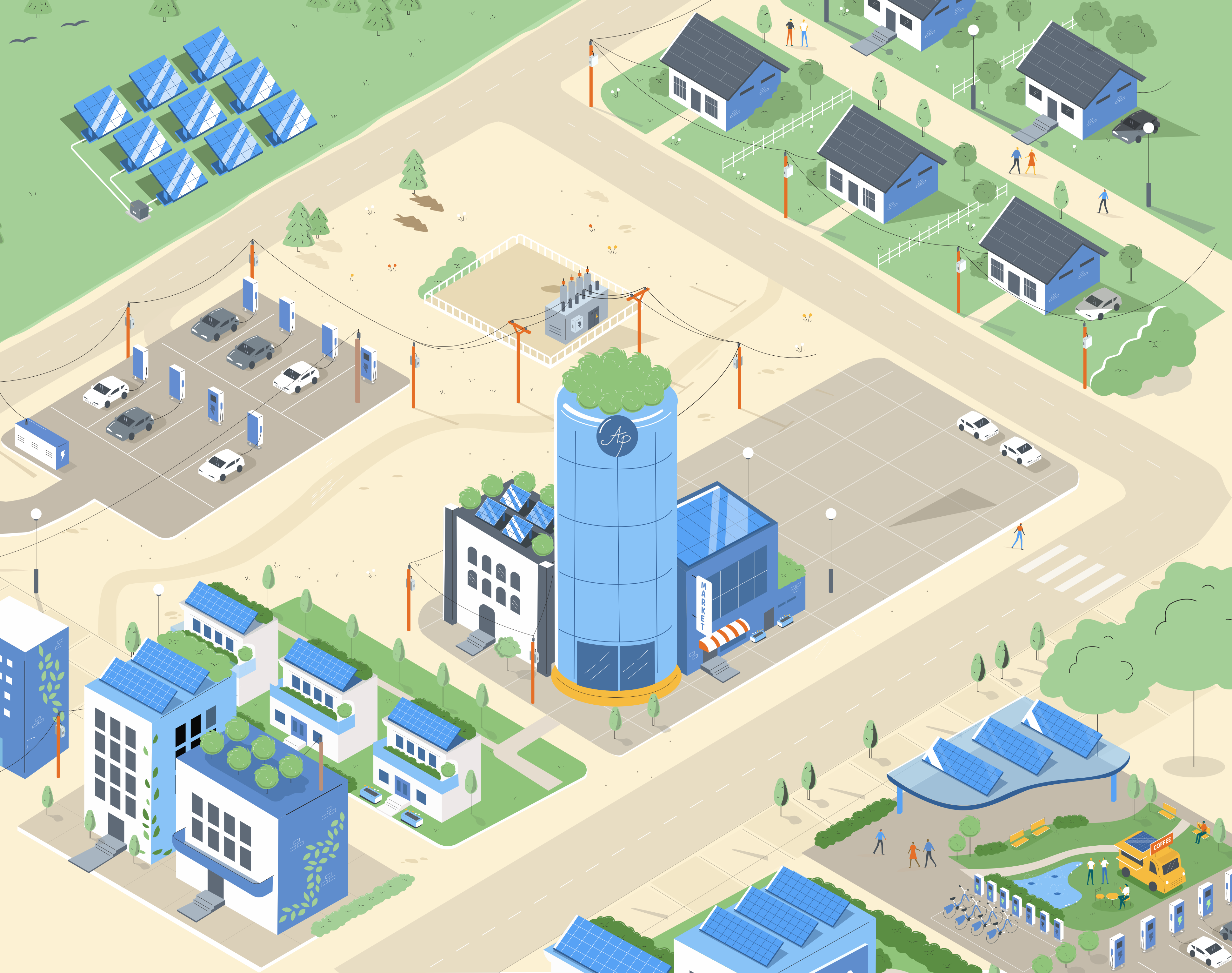
The town’s utility, Albertville Power & Light (APL), has received several new project requests. Come along as grid operators problem-solve how to get them all powered up using flexible grid connections.
We’ve received a new project request.
But the grid is already at capacity.
Congratulations!
You were able to add 3 new projects to the grid without expanding its capacity!
A 100 MW data center is looking to connect to APL’s grid.
APL’s planning team starts where they always do: an interconnection study to determine whether the grid can handle the new load. Their analysis flags overloading on the local transmission line during peak summer afternoons — the handful of hours each year when system demand is highest. Absorbing the project would require a major transmission upgrade, and APL already has a queue of upgrades ahead of it. Under the standard process, the data center would wait 5 to 7 years to come online.
Fortunately, APL recently launched a flexible connection program. The study shows the constraint only bites for ~60 hours each year during the highest-demand summer afternoons. With a flexible connection, the data center can connect immediately. During those ~60 hours, the site reduces its grid draw using on-site batteries, generation, or compute flexibility. The rest of the year, it runs normally.
What does this look like for a real data center?
A recent study modeled six 500 MW data center sites in PJM and asked whether a small amount of on-site flexibility could speed their connection. The answer: all six could connect three to five years faster than under traditional rules — drawing grid power more than 99% of the time, with on-site resources running just 40 to 70 hours a year.
A 5 MW community solar project is looking to connect to a rural feeder on the outskirts of Albertville.
APL’s planning team runs the interconnection study and finds an issue: overvoltage. During sunny spring afternoons, the feeder is already running close to its voltage limit. Pushing 5 MW back onto the line at midday would push voltage out of spec. Under the standard process, the project would have to wait for and pay for a feeder upgrade, an impact that could kill the project’s economics.
Fortunately, APL’s flexible connection program helps here too. The study shows voltage varies dramatically by season: there’s plenty of room most of the year, including most sunny days. The constraint only bites for ~200 hours, almost all of them clear spring afternoons with lots of solar generation and little residential air conditioning demand. With a flexible connection, the project can connect immediately. During those ~200 hours, the array reduces its export to keep the feeder in spec. The rest of the year, it generates at full capacity.
How often does this really happen?
ComEd has fast-tracked more than 50 MW of community solar projects in Illinois using flexible interconnection, with another 25 MW approved in early 2026. Other states — including Maryland, Massachusetts, and New York — are now starting to follow the same model.
A 1 MW EV charging depot is looking to connect on the east side of Albertville.
APL’s planning team studies the interconnection and finds the issue isn’t the depot’s size — it’s the timing. The trucks return between 5 and 7 PM and need to be ready by 6 AM. That charging window overlaps with the residential evening peak, when the feeder is already at its limit. Under the standard process, the project would require a feeder upgrade before it could connect.
Again, APL’s flexible connection program comes to the rescue. The study shows the feeder is only constrained for a few hours on warm summer evenings, roughly 180 hours each year. Outside those windows, there’s ample capacity. With a flexible connection, the depot can connect immediately. During those ~180 hours, charging shifts to off-peak hours. The trucks are still fully charged by 6 AM, and the fleet operator pays lower off-peak rates for the energy.
Where is this happening?
PG&E’s Flex Connect program is bringing EV charging sites and battery projects online roughly 18 months faster than traditional interconnection. Pepsi used it to expand its electric semi-truck fleet to 4.5 MW of charging capacity well ahead of schedule, without waiting for grid upgrades.
Three new projects — a 100 MW data center, a 5 MW community solar farm, and a 1 MW EV depot — have just connected to APL’s grid. Here’s what that looks like from inside APL.
The planning team’s job is to figure out how much capacity is available on each feeder or substation, when, and under what conditions. Instead of running a static analysis of seasonal profiles or worst-case peak hours, they model all 8,760 hours of the year. That’s how they spot the headroom that traditional studies miss, and how they decide what conditional capacity can safely be offered to each project.
The operations team takes over once a project is live. When the grid has headroom, the sites run totally normally. When a constraint approaches, operators send an updated operating limit to the affected site, and it responds within minutes: adjusting consumption or generation to stay within the grid’s limits.
Both utility teams work from the same data and the same grid model. That’s what makes flexible connections trustworthy enough to plan around and reliable enough to operate.
How are utilities making this work?
PG&E, Avangrid, ComEd, National Grid, and SCE are all running flexible interconnection programs — and sharing what they’re learning. This Camus piece walks through the operational lessons, the shift from point-in-time to time-series planning, and where the work is heading next.
A flexible connection works when both sides can rely on it. Let’s take the 100 MW data center for example.
The data center developer needs to know exactly when flexibility will be required — and how much — so they can design and procure the right mix of batteries, generation, or compute flexibility to keep the site running around the clock. After all, a data center has customer obligations that don’t pause when the grid is constrained.
The utility, meanwhile, needs to know it can count on flexibility when the grid needs it — turning flexible connections into a lever the operations team trusts to alleviate network constraints.
That trust is built on a shared view of the grid. Modern interconnection software gives both the utility and the developer the same picture of where capacity is firm, where it’s conditional, and exactly when constraints will arise. The utility plans and operates against that picture. The developer designs and operates against the same one. When something on the grid changes, both sides see it and act on it together.
That’s how three new projects come online without waiting on grid upgrades.
How do utilities and data centers actually agree to this?
Camus CEO Astrid Atkinson and Princeton’s Jesse Jenkins join David Roberts on Volts to talk about why utilities and data centers have been “two shy people at a dance” — and what it takes for both sides to commit.